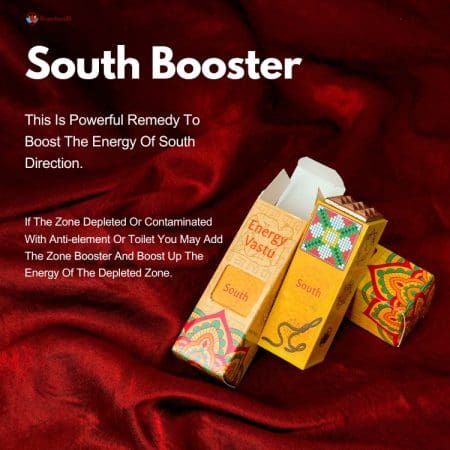
The Remedywala South Booster, also known as the Dakshin Booster, is a traditional Vastu remedy designed for symbolic use in the South (Dakshin) zone of homes, offices, shops, factories, and commercial properties. According to Vastu Shastra, the South direction is one of the nine primary Vastu zones and is considered during the planning and evaluation of residential and commercial spaces.
According to traditional Vastu Shastra, a property is divided into nine zones: North, North-East, East, South-East, South, South-West, West, North-West, and the Center. If any one of these nine zones is considered depleted, for example, because of an unfavorable color scheme, an “anti-element,” or a toilet located in that zone, this Booster is traditionally used to symbolically support the energy of that specific zone. When the South zone contains a toilet, some Vastu practitioners recommend first placing a Toilet Blocker/Pacifier inside the toilet, checking the zone, and adding a South Booster outside the toilet if it’s still considered depleted.
The South Booster is intended to be installed in locations identified through a professional Vastu assessment when symbolic remedies are recommended instead of structural modifications. It’s commonly used as part of a comprehensive Vastu correction plan to symbolically support the South zone when it’s considered depleted or affected by unfavorable placements according to traditional Vastu principles.
This product is a traditional Vastu accessory and should not be regarded as a substitute for architectural planning, engineering, electrical safety, or professional building advice.
According to traditional Vastu beliefs:
These interpretations are based on traditional Vastu Shastra and cultural beliefs and are not scientifically established.
People commonly choose the South Booster for:
This product may be suitable for:
It is intended purely as a traditional Vastu accessory. It is not intended to diagnose, treat, cure, or prevent any disease or medical condition.
It’s a traditional Vastu accessory, also known as the Dakshin Booster, intended for symbolic balancing of the South (Dakshin) direction according to Vastu Shastra.
According to traditional Vastu practice, it’s used when a qualified consultant recommends symbolic remedies for a South zone considered depleted or contaminated by an unfavorable color or element, including when a toilet is located there.
Some Vastu consultants recommend placing a Toilet Blocker inside the toilet first, checking the zone, and adding a South Booster outside the toilet in the South zone if it’s still considered depleted.
Placement depends on the property’s layout and should follow the manufacturer’s instructions or the recommendations of a qualified Vastu consultant after a Vastu assessment.
Yes. It may be installed in homes, offices, shops, factories, and commercial buildings where traditional Vastu practices are followed.
No. It’s intended as a symbolic traditional remedy and does not replace architectural planning, engineering solutions, or structural modifications.
Yes. It may be used alongside traditional Vastu accessories such as pyramids, helixes, metal strips, directional balancers, toilet pacifiers, and other symbolic remedies.
Minimal maintenance is required. Keep it clean, dry, and securely installed, and periodically check its condition.
Although installation is generally simple, consulting a qualified Vastu expert can help determine the appropriate location based on the property’s directional zones.
No. There is no scientific evidence that the South Booster removes Vastu doshas, improves energy, success, prosperity, or guarantees specific life outcomes. Its use is based on traditional Vastu belief and personal faith.
Yes. It can be a thoughtful gift for homeowners, office owners, architects, builders, Vastu practitioners, or individuals interested in traditional Vastu practices.
Sale
Sale
Sale
Sale
Sale
Sale
Sale
Sale
Sale
Sale
Sale
Sale
Please sign in to save products to your wishlist.
Enter your registered email address and we'll send you a reset link.